
Sedgwick Projected Versus Actual Release
A projected date is a sentence calculation based on facts known at that time. KDOC calls its public field the Anticipated release date. The estimate can move as credits, discipline, court action, sentence structure, and custody interruptions change. It does not prove that a gate release occurred on that day. KASPER status and movement history, followed by KDOC confirmation, provide the later event.
County cases work differently. A pretrial detainee is held pending the court process and normally has no sentence-based release date. Bond, own-recognizance orders, warrant holds, transfers, and processing decide when Sheriff custody ends. For a local jail sentence, use the sentencing journal entry, jail-credit finding, and the Sheriff’s computation. No official Sedgwick jail good-time calculator was found.
Find Sedgwick Release Date Records
Start by deciding whether Sedgwick County Sheriff, KDOC, or another agency holds the person. Search identifiers are more reliable than name alone. A booking number belongs to the county episode; a KDOC number follows the state correctional record.
- Check the Sheriff search. A current match means the person remains in county custody, subject to the roster’s update warning.
- For a county case, call 316-660-5245 for the automated information menu and review the sentencing or bond order.
- If the person entered state custody, open KASPER, accept its disclaimer, complete the CAPTCHA, and search by KDOC number or identifying fields.
- Read the exact KASPER labels for status, location, movements, anticipated release, conditional release, maximum date, and supervision.
- Resolve uncertainty with KDOC’s Sentence Computation Unit at 785-296-3317 or with a focused records request.
The full Sedgwick release search adds VINE, court records, and KORA when the main question is whether a county event already ended.
The official KASPER entry documents the state search scope and disclaimer.
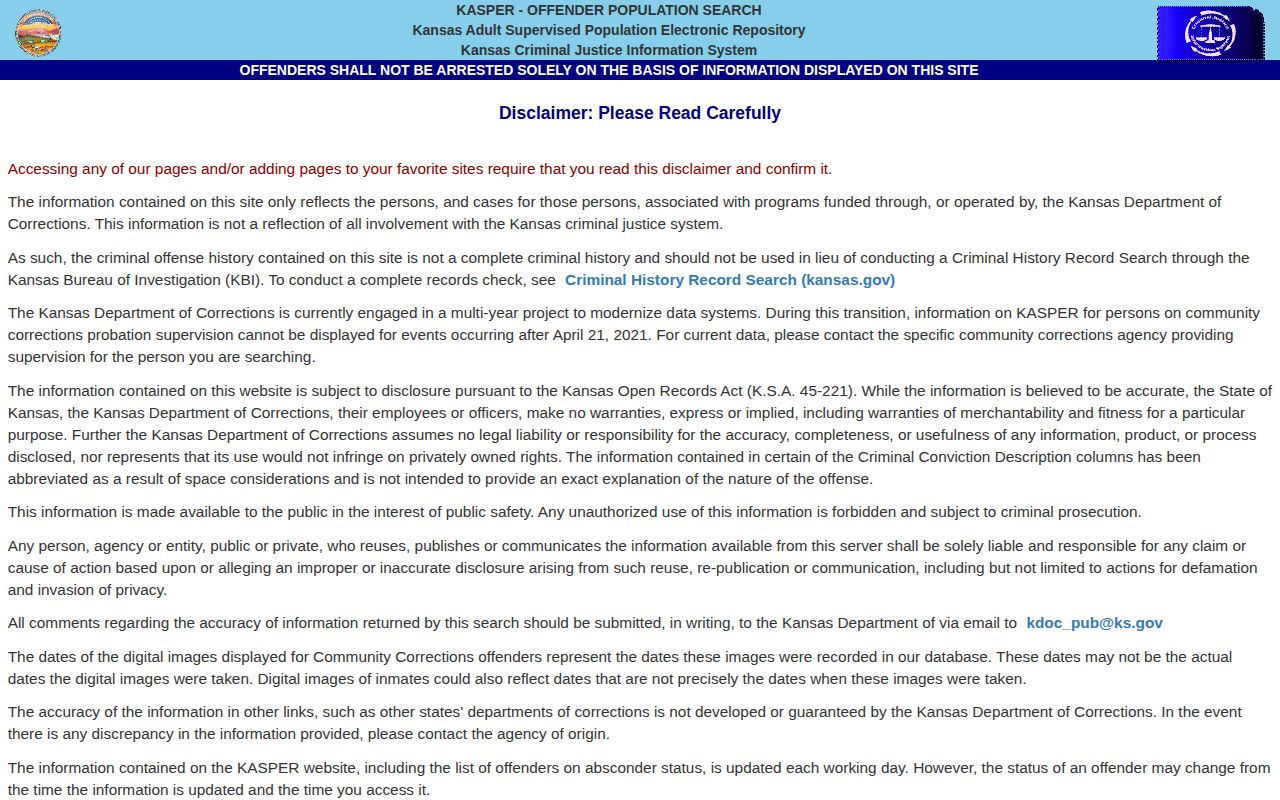
This state screen applies to KDOC records, including Wichita Work Release Facility, rather than a county-jail-only bond release.
Kansas Good Time Calculations
K.S.A. 21-6821 authorizes KDOC good-time rules for sentencing-guidelines cases. For many crimes committed on or after July 1, 1993, the ordinary maximum is 15 percent of the prison portion. That creates the common 85 percent shorthand only when all available credit is earned. The statute permits up to 20 percent for specified lower-severity categories and offense dates, so the shortcut is not universal.
Credits may be earned, awarded, withheld, or forfeited. Authorized program credits can also affect the calculation. For specified sexually violent or sexually motivated crimes, time taken off the prison portion through good time is added to postrelease supervision. Earlier prison departure therefore does not necessarily shorten the whole sentence obligation.
K.S.A. 21-6615 governs jail credit recorded in the sentencing order and limits improper double credit. Older sentence structures may involve K.S.A. 22-3725. Only the official computation can reconcile offense date, concurrent or consecutive terms, prior confinement, and interruptions.
Why Sedgwick Release Dates Change
Even a correctly copied date can become stale. Use the current record and preserve its label, capture date, and custodian.
| Factor | Possible effect |
|---|---|
| Earned or program credit | May move an eligible KDOC estimate earlier. |
| Disciplinary loss | Withheld or forfeited good time can move the date later. |
| Jail credit | A court’s lawful confinement credit affects the sentence start and computation. |
| Detainer or warrant | The first custodian may release the person to another agency. |
| Court order or appeal | Sentence changes can alter the controlling terms. |
| Board action | Parole approval, denial, continuance, rescission, or revocation can affect older-system cases. |
| Escape or absconding | An interruption or supervision event may affect service and status. |
KASPER updates each working day, not in real time. Its disclaimer also says community-corrections probation events after April 21, 2021 cannot currently display. Contact Sedgwick County Community Corrections for that gap instead of reading an incomplete event as discharge.
Confirm Sedgwick Actual Release
For adult county-jail custody, a VINELink check may report release or transfer. The Sheriff automated line supplies a fast second channel, while the booking and release sheet supplies durable fields such as date, reason, authority, and receiving agency. The district or municipal court record explains the order behind the jail action.
For state custody, inspect KASPER’s status and movement history after the anticipated date. Parole, conditional release, and postrelease mean prison custody ended while supervision continues. Sentence discharge or maximum sentence date means the KDOC obligation shown has ended. Those labels must not be treated as synonyms.
If a Sedgwick name leaves the county roster and appears in KASPER, the event may have been a transfer to KDOC. If neither source resolves the outcome, request the county release line and identify any destination. A conflict should be reported as a conflict, followed by the agency contact needed to resolve it.
Sedgwick Custody Date Paths
The main Adult Detention Facility and Sheriff’s Annex are county operations. Their dates come from Sheriff records, VINE events, and the controlling court. Wichita Work Release Facility is a state correctional facility. Its residents require KASPER, KDOC records, and the state sentence computation. Federal sentences require the BOP locator and federal docket.
- Anticipated release
- KDOC’s forecast for a future custody event.
- Postrelease supervision
- Community supervision after the prison portion of a guideline sentence.
- Conditional release
- A statutory release under an indeterminate sentence, followed by supervision.
- Sentence discharge
- The end of the KDOC sentence and supervision obligation shown.
Keeping these paths apart matters more than finding a single date. A date without a custodian and label is easy to misread. Record it as “anticipated KDOC release” or “released from Sedgwick County Sheriff custody,” then verify the later event.
Note: No official Sedgwick weekend-release rule or county good-time calculator was verified, so state formulas should not be applied to local detainees.
Public Record Search
Sponsored Results
Parole Dates Are Not Release
Some older indeterminate Kansas sentences involve parole eligibility and Prisoner Review Board action under K.S.A. 22-3717. Eligibility means the person may be considered. A public-comment session, offender list, or hearing date is not an approved release date. The Board may grant parole, pass the case to a later period, continue it for more information, or take another authorized action.
Even approval is followed by release processing. KASPER status and the later movement entry provide stronger confirmation that prison custody actually ended. Most guideline sentences for crimes committed after July 1, 1993 do not follow the ordinary parole path; they generally lead from the prison portion to mandatory postrelease supervision, subject to statutory exceptions. Match the offense date and sentence type before using parole terms.
Request Sedgwick Date Computations
When a public screen cannot resolve the estimate, ask the office that owns the computation. For a local jail sentence, request the existing Sheriff calculation or release record and pair it with the sentencing journal entry. For a state sentence, contact the KDOC Sentence Computation Unit or use the department’s KORA guidance. Supply the KDOC number, case, county of conviction, and the exact date field in question.
A request should seek a maintained document, movement history, or calculation, not ask staff to create a new forecast. For the county, identify the booking episode and request the release date, release authority, and receiving agency if custody ended. For KDOC, ask for the public computation or release and discharge history. A response can clarify whether the displayed date concerns prison release, conditional release, supervision, or maximum sentence discharge.
Dates from different agencies may both be accurate because they describe different layers. A Sheriff release-to-KDOC date ends county custody. A later anticipated KDOC date forecasts prison departure. A still later maximum date may mark sentence discharge. Label each date with its custodian and purpose.
Federal and immigration dates require separate care. A BOP locator result may show a past federal release date and “Released” or “Not in BOP custody,” yet another correctional system or supervision may still apply. “In transit” is not release. If the county sheet names an immigration handoff, the ICE locator and receiving office address that later custody layer. A detainer by itself does not prove the transfer occurred.
Juvenile custody also falls outside the adult workflow. The Sedgwick County Juvenile Detention Facility follows different access and confidentiality rules. Do not search for a youth through adult roster, KASPER, or VINE instructions unless an authorized official channel directs that action. The juvenile court or facility must control any status confirmation.
Read Sedgwick KASPER Fields
KASPER means Kansas Adult Supervised Population Electronic Repository. It covers people and cases tied to KDOC-operated or KDOC-funded programs. It is not a full Kansas criminal history, and it does not include every adult who spent time in the Sedgwick County jail. Search by KDOC number for the strongest match. When that number is unknown, use name, alias, date of birth, age, conviction county, and other available fields to distinguish similar records.
The public record can include the person’s name and KDOC registration number, physical description, photograph, conviction crime and case, anticipated release date, current location, facility movement dates, supervising parole office, custody or supervision level, and institutional discipline. Not every category is populated in every record. KASPER also cautions that the date an image was recorded may not be the date the photograph was taken.
For a former state prisoner, read status beside movement and sentence fields. Parole, postrelease supervision, conditional release, discharged, released, and absconded have distinct meanings. Parole or postrelease usually shows that incarceration ended while supervision remains. Discharge generally marks the end of the KDOC sentence and supervision obligation displayed. An absconder remains under legal obligation and should not be treated as discharged.
Sedgwick Court Date Evidence
The court record supplies inputs that a custody locator may not explain. Search the Kansas District Court Public Access Portal and Eighteenth Judicial District resources by case number when possible. Review the sentencing journal entry, jail-credit entry, bond order, probation order, warrant status, revocation, and commitment. Wichita ordinance cases remain in Municipal Court, while state felony and misdemeanor matters proceed in Sedgwick District Court.
A journal entry stating time served or ordering release does not always prove the physical exit time. Jail processing and an unrelated hold may intervene. In the other direction, a Sheriff release record can show when county custody ended without resolving the charge or the full sentence. Pair both records when a precise date matters.
The district court clerk’s records office can supply public documents that do not appear through remote access. An exact case number reduces identity risk and can reduce staff research. Sealed and expunged material remains unavailable through ordinary public channels. If the court date and KASPER estimate conflict, preserve both labels and ask the agency that owns the computation instead of choosing the more convenient date.