
Sedgwick Parole and Probation Compared
Leaving the jail does not show whether supervision follows. The court sentence and corrections record establish that fact. Kansas uses several terms that sound alike but arise at different points:
| Status | How it begins | Where to verify |
|---|---|---|
| Parole | Prisoner Review Board approval under the older indeterminate system | KASPER and KDOC Parole Services |
| Postrelease supervision | Follows the prison portion of many guideline sentences | KASPER and Wichita Parole Office |
| Probation | Court sentence allowing community supervision | Sentencing order, court services, or community corrections |
| Pretrial supervision | Bond or own-recognizance release before disposition | Court file and Sedgwick County Pretrial Services |
A county-jail release on bond does not make someone a parolee. A person leaving state prison under postrelease supervision is not on county probation merely because the conviction arose in Sedgwick County. Use the official label. The KDOC glossary also distinguishes conditional release, mandatory release, parole, and final sentence discharge.
Conditional release is a statutory state-prison release under an indeterminate sentence after the applicable credit calculation. It is followed by supervision. Mandatory postrelease generally follows the prison term imposed under the guideline structure. By contrast, a Sedgwick County judge can place a person on probation without a prison release at all. These distinctions affect both the agency holding the record and the date on which the legal obligation ends. A jail date, a prison movement date, and a sentence-discharge date should never be merged into one unqualified “release date.”
- Discharge
- The end of the sentence or supervision obligation shown by the responsible agency.
- Absconder
- A person whom the supervising authority reports as out of contact or noncompliant.
- Revocation
- An official action that withdraws a community status after a violation process.
Verify Sedgwick Post-Release Supervision
The best path starts with the legal source of supervision, not the live jail roster. That roster covers current Sheriff custody and normally drops the person when the local episode ends.
- Read the district or municipal court file for the sentence, probation order, bond terms, revocation, or commitment to KDOC.
- For a state sentence, open KASPER, accept the disclaimer, and search by KDOC number when known.
- Review current status, movement history, sentence cases, supervising office, and release or discharge labels. Do not treat an anticipated date as an event.
- Call the Wichita Parole Office when KDOC parole or postrelease data is unclear or has not reached the next working-day update.
- For probation, contact the court-listed agency. Sedgwick County Community Corrections is important because KASPER cannot currently display community-corrections probation events after April 21, 2021.
KASPER is not a full criminal-history report. It covers people and cases tied to KDOC-operated or funded programs. A county-jail-only release may never appear there. Match the KDOC number, date of birth, conviction county, and case instead of relying on name or photograph alone.
KASPER updates each working day, so a new movement or supervision change can take time to appear. Its photo is only an identity aid, and the system warns that the recorded image date may differ from the day the photograph was taken. If the public record conflicts with a court order or a direct KDOC response, keep each source’s date and label. Ask the agency to reconcile the difference instead of selecting the result that seems most convenient.
Wichita Parole Office Verification
The Wichita Parole Office is the local human route for KDOC parole and postrelease questions. Its South Region coverage includes Sedgwick, Cowley, and Sumner counties. This office is not county probation, community corrections, or Pretrial Services.
Wichita Parole Office212 S. Market St.
Wichita, KS 67202
316-262-5127
KDOC automated reporting: 866-570-7225
The automated number is a reporting channel for supervised clients, not a tool for guessing whether another person complied. A public KASPER status and direct agency confirmation are the proper verification sources.
The official contact listing shows the local office and its regional service area:
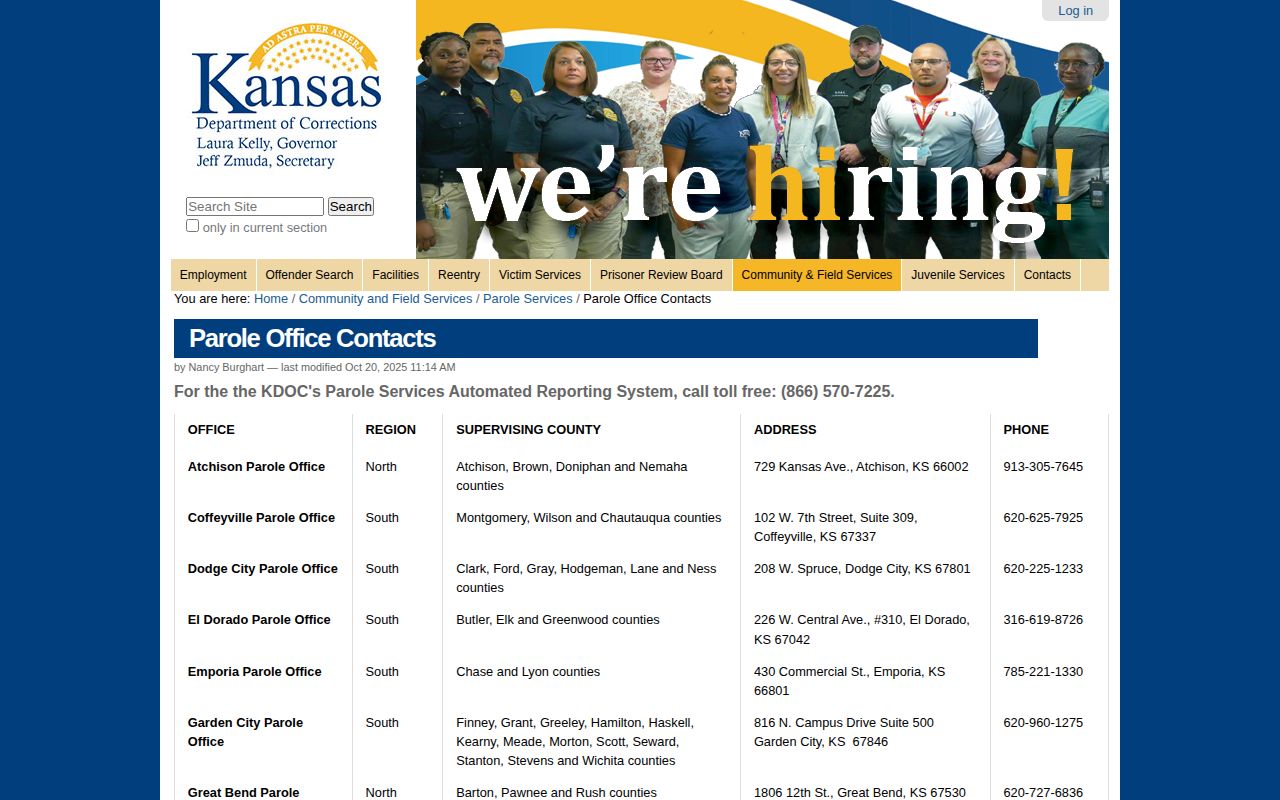
The KDOC page supplies the office route, while the individual record determines whether that office actually supervises the person.
Sedgwick Supervision Warrants and Absconders
KASPER has separate parole-absconder and community-corrections-absconder navigation. An absconder label means the authority reports lost contact or noncompliance. It does not mean that the sentence ended, that the person is in the county jail, or that every court issued a warrant. Location information should go to law enforcement or KDOC, not to a personal encounter.
The Sedgwick County Sheriff warrant search, Wichita Municipal Court warrant tools, and KASPER absconder lists answer separate questions. A warrant can remain after release, but wanted status does not explain the earlier custody-ending event. The issuing court and case identify the warrant. The Sheriff roster shows whether it has led to current county custody.
When Sedgwick Supervision Ends
Final discharge must come from the supervising authority or court record. In KASPER, parole, postrelease, or conditional release commonly means prison confinement has ended but KDOC supervision continues. “Sentence Discharge/Maximum Sentence Date” marks the end of the sentence obligation and KDOC supervision shown. Probation ends under the court’s order, after successful completion or another disposition.
The difference matters for release records and expungement timing. Common waiting periods under K.S.A. 21-6614 can run from discharge from probation, community corrections, parole, postrelease supervision, conditional release, or a suspended sentence, not just from departure from jail. The Sedgwick County released-inmate search and record page explains how the custody-ending sheet and court order fit beside the supervision record.
Sedgwick Probation Service Channels
Sedgwick County Pretrial Services at 905 N. Main, 316-660-1740, evaluates people for certain release alternatives and supervises some defendants before the case ends. That is not post-sentence probation. The Adult Residential Center and Service Center at 623 E. Elm and 622 E. Central, 316-660-9500, serve probation and direct-commitment clients.
Presence in one program should never be inferred from a jail release. Review the bond or sentencing order, identify the named agency, and contact only that office. A court services probation file and a community corrections record may have different access rules from a KDOC parole record.
Sedgwick Supervision Record Corrections
Detention Administrative Services provides a $0.25 face sheet showing incarceration dates. A person’s own rap sheet is free within 24 hours after release and $0.25 afterward. Another person’s rap sheet requires a court order. These jail products document custody dates, not the full terms of parole or probation.
For an error in the online Sheriff data, the roster disclaimer directs a written complaint to Lt. James Convey at 141 W. Elm, Wichita, KS 67203. KASPER corrections go in writing to kdoc_pub@ks.gov. Send the correction to the agency that owns the disputed field and include the identifying record number and source document.
Sedgwick Parole Hearing Records
The Kansas Prisoner Review Board calendar publishes monthly public-comment sessions and offender lists. A listed person is being considered under the relevant process. The list is not a release decision, and the county of conviction is not necessarily the return county.
The Board can grant parole, pass the case for later review, continue it for more facts, or require fuller review. Most guideline sentences after July 1, 1993 lead to mandatory postrelease supervision rather than ordinary discretionary parole, apart from off-grid and other statutory exceptions. Do not assume every KDOC resident receives a parole hearing.
Under K.S.A. 22-3717, eligibility and release structures depend on the sentence framework and detailed statutory exceptions. For an older indeterminate sentence, eligibility generally follows service of the court-imposed minimum less lawful credit. Eligibility still does not guarantee approval. Institutional conduct, program information, official comments, risk facts, proportionality, and other Board considerations can affect suitability. A later rescission or revocation can also prevent or undo a planned community status.
No separate public Board-decisions search comparable to KASPER was verified. Use the current schedule and Board process page to understand the stage, then check KASPER and contact the Prisoner Review Board when the outcome remains unclear. The Board’s central contact is at the KDOC office in Topeka, while the Wichita Parole Office handles the local field-supervision route once that status begins.

The schedule proves a hearing stage and potential timing only. Confirm the later outcome through KASPER and the Board or KDOC contact.
Public Record Search
Sponsored Results